
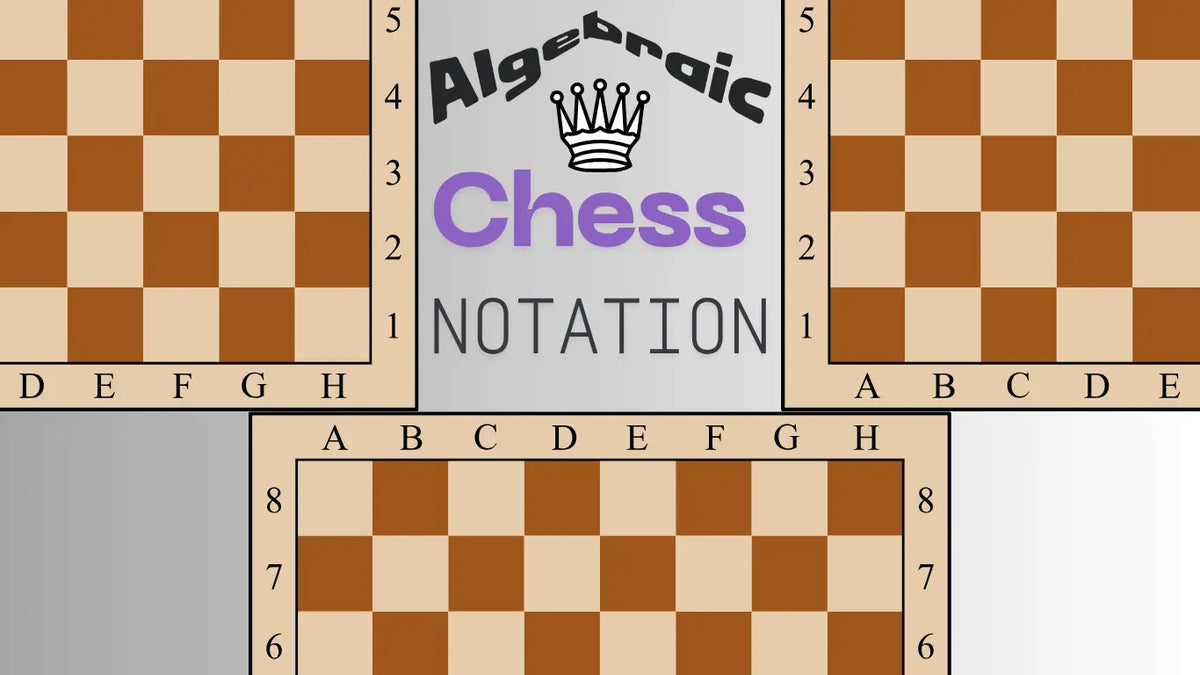
Master chess algebraic notation with this complete beginner's guide. Learn to read, write and understand chess moves like a pro with clear examples and practice exercises!
Ever watched a chess video and felt confused by mysterious symbols like e4 or Nf3? You're not alone! These aren't random codes—they're part of algebraic chess notation, the universal language that chess players worldwide use to record and share their moves. Once you master this simple system, you'll unlock access to grandmaster strategies, classic chess literature, and be able to analyze every game you play.
Think of chess notation as learning to read a map. Just like every location has an address, every square on the chessboard has its own unique coordinate. Let's decode this friendly system step by step.
What is Chess Algebraic Notation?
Algebraic chess notation is the standard method for recording chess moves using a coordinate system. Each square on the chessboard receives a unique name by combining a letter (file) and number (rank). For example, e4 refers to the square located at the intersection of the e-file and 4th rank.
This notation system was developed to replace older, more complex methods and has become the international standard recognized by FIDE (World Chess Federation). Whether you're reading a chess book in New York or watching a tournament in Mumbai, the notation remains exactly the same.
Chess Board Coordinates Explained: The 64-Square Map
Imagine the chessboard as a perfectly organized grid—eight columns intersecting with eight rows—where every square has its own postal address.
Files (Vertical Columns: a-h)
Files are the vertical "streets" running from White's left to right, labeled a through h. Think of them as the columns on a spreadsheet:
a-file: leftmost column from White's perspective
h-file: rightmost column from White's perspective
Ranks (Horizontal Rows: 1-8)
Ranks are the horizontal "lanes" numbered 1 through 8:
1st rank: White's back row (where White's pieces start)
8th rank: Black's back row (where Black's pieces start)
Essential Setup Rule
Always remember: "White on the right"—the bottom-right square (h1) should be light-colored when setting up your board. This ensures proper orientation for notation.
Example
The square e4 sits exactly where the e-file meets the 4th rank. It's that simple!
Chess Piece Symbols and Abbreviations
In algebraic notation, each piece wears a single-letter badge—except pawns, which go nameless
Piece
Symbol
Example Move
Why This Symbol?
King
K
Kf1
King
Queen
Q
Qd5
Queen
Rook
R
Ra8
Rook
Bishop
B
Bc4
Bishop
Knight
N
Nf3
Night (K was taken!)
Pawn
(none)
e4, d5
Most common piece
Important Note: The Knight uses "N" (not "K") because "K" is reserved for the King. When you see just a square name like d4, it always means a pawn moved there.
How to Write Basic Chess Moves
The formula is beautifully simple:
Piece Letter + Destination Square
Basic Move Examples:
Bc4 means "Bishop moves to c4"
Qh5 means "Queen moves to h5"
e4 means "Pawn moves to e4"
Nf3 means "Knight moves to f3"
Writing Your First Game
Let's record the opening moves of a famous game:
e4 (White pawn to e4)
.. e5 (Black pawn to e5)
Nf3 (White knight to f3)
.. Nc6 (Black knight to c6)
Notice how each move number is followed by White's move, then Black's move.
Recording Captures and Special Moves
Captures with an "x"
When a piece captures another piece, insert an "x" between the piece and destination:
Nxe5 (Knight captures whatever is on e5)
Bxf7 (Bishop captures on f7)
exd5 (Pawn from e-file captures on d5)
Pawn Captures: Since pawns have no letter symbol, show which file the capturing pawn came from: exd5 means the pawn on the e-file captured something on d5.
Special Chess Symbols
Symbol
Meaning
Example
+
Check
Qh5+
#
Checkmate
Qg7#
0-0
Kingside castling
0-0
0-0-0
Queenside castling
0-0-0
=Q
Pawn promotion
e8=Q
Game Results
When the game ends, record the result:
1-0: White wins
0-1: Black wins
½-½: Draw
Advanced Notation: Avoiding Confusion
Sometimes two identical pieces can reach the same square. When this happens, you must disambiguate (clarify which piece moved):
Disambiguation Examples:
Rad1 (Rook from a-file to d1)
R1d5 (Rook from 1st rank to d5)
Nge2 (Knight from g-file to e2)
N5f3 (Knight from 5th rank to f3)
Chess Notation Examples with Diagrams
Let's trace through a complete mini-game with notation:
The Scholar's Mate (4-move checkmate):
e4 e5
Bc4 Nc6
Qh5 Nf6?? (Terrible move!)
Qxf7# (Checkmate!)
What happened
White's queen captured the f7 pawn, delivering checkmate because Black's king cannot escape.
Common Chess Notation Mistakes to Avoid
Even experienced players make these errors:
Top 5 Notation Mistakes:
Forgetting captures: Writing Nf5 instead of Nxf5
Wrong castling: Writing O-O-O for kingside (should be O-O)
Lowercase pieces: Writing "n" instead of "N" for knight
Reversed coordinates: Writing 4e instead of "e4"
Missing check symbols: Forgetting the "+" after giving check
Pro Tip
Always double-check your notation, especially during tournament games where accurate recording is mandatory.
Practice Exercises and Score Sheets
Exercise 1: Basic Notation
Try writing these moves in algebraic notation:
White moves pawn to d4
Black moves knight to f6
White moves bishop to g5
Black captures the bishop with the knight
Answers: 1.d4 Nf6 2.Bg5 Nxg5
Using Score Sheets in Tournaments
In official tournaments, you must record every move on a score sheet. Here's what you need to know:
Record your move and opponent's move after each turn
Use pen (not pencil) for permanent records
Write clearly—illegible notation can cause disputes
Include game information: your name, opponent's name, date, round
Record every game—become the historian of your own chess journey
Start with slow games to build accuracy
Use physical score sheets before relying on digital tools
2. Study Master Games
Replay famous matches using notation from chess books
Follow along with grandmaster games online
Predict moves then check against the actual game
3. Join the Community
Participate in tournaments where notation is required
Share your games with other players for analysis
Learn from corrections when you make notation errors
Frequently Asked Questions
How do you write algebraic notation in chess?
Write the piece letter (K, Q, R, B, N) followed by the destination square. Pawns use only the square name. Example: Nf3 (knight to f3), e4 (pawn to e4).
What does "d4" mean in chess notation?
d4 means a pawn moved to the d4 square. The "d" indicates the d-file (4th column from White's left).
How do you show check in notation?
Add a "+" symbol after the move. Example: Qh5+ means the queen moved to h5 and gave check.
Use an "x" between the piece and destination square. Example: Nxe5 (knight captures on e5), exd4 (e-pawn captures on d4).
How do you show pawn promotion?
Use "=" followed by the new piece. Example: e8=Q (pawn promotes to queen on e8).
What is disambiguation in chess notation?
When two identical pieces can reach the same square, specify which piece moved by adding the file or rank. Example: Rad1 (rook from a-file to d1).
Master Chess Notation Today
Congratulations! You now possess the key to chess's universal language. Algebraic chess notation opens doors to:
Studying grandmaster games from any era
Participating in tournaments worldwide
Sharing your games with the global chess community
Analyzing positions with precision and clarity
Remember
Like learning any language, chess notation improves with practice. Start recording your games today, and within weeks, reading and writing moves will become second nature.
Your chess adventure awaits—equipped with notation skills, you're ready to explore the infinite world of chess knowledge, one move at a time!
Ready to put your notation skills into practice? Visit ChessBazaar.com for premium wooden chess sets perfect for recording your memorable games on quality boards that will last generations. Every great chess journey begins with the right equipment and the knowledge to document it properly.
A wooden chess set is more than just a board game—it's an investment in craftsmanship, strategy, and tradition. Whether you're buying your first chess set, upgrading to tournament-quality equipment, or adding a handcrafted masterpiece to your collection, choosing the right set can significantly enhance your playing experience.
At CHESSBAZAAR, we've spent years working with skilled artisans who handcraft chess pieces using traditional woodworking techniques and carefully selected hardwoods. During this time, we've learned that no single chess set is perfect for everyone. The ideal choice depends on how you play, where you play, and what you expect from your chess set.
Some players want a tournament-ready Staunton set that meets regulation standards. Others are drawn to luxury collector's pieces crafted from premium woods such as ebony or rosewood. Many buyers simply want a durable, beautifully made set they can enjoy with family and friends for years.
This guide is based on practical buying considerations, craftsmanship standards, and the questions our customers ask most frequently. By the end, you'll know exactly what to look for when choosing a wooden chess set that suits your playing style, budget, and long-term needs.
Why Wooden Chess Sets Remain the Gold Standard
Although plastic and composite chess sets have their place—particularly in schools and casual clubs—wooden chess sets continue to be the preferred choice of serious players, collectors, and enthusiasts.
The difference becomes clear the moment you pick up a well-crafted wooden chess piece. A properly weighted king feels balanced in your hand, the natural grain of hardwood gives every piece a unique character, and the smooth finish allows pieces to glide effortlessly across the board.
Unlike mass-produced alternatives, quality wooden chess sets are designed to last for decades. With proper care, they often become heirloom pieces passed down through generations.
At CHESSBAZAAR, many of our chess pieces are individually hand-carved by experienced artisans rather than machine-moulded. This attention to detail gives every knight, bishop, and rook a level of character that cannot be replicated through automated manufacturing.
If you're exploring your options, our Wooden Chess Sets collection includes everything from beginner-friendly designs to museum-quality collector's pieces.
Step 1: Start by Understanding How You'll Use Your Chess Set
One of the biggest mistakes buyers make is choosing a chess set based solely on appearance.
A beautiful luxury chess set may not be the best choice for daily practice, while a tournament chess set may not provide the decorative appeal some collectors are looking for.
Before comparing woods or piece designs, ask yourself these questions:
Will this be your primary playing set?
Are you purchasing it as a decorative display?
Will you travel with it regularly?
Are you buying it as a gift?
Are you building a long-term chess collection?
Your answers will help narrow your options considerably.
For Everyday Players
If you play several games each week, durability should be your highest priority.
Look for:
Hardwood construction
Weighted pieces
Comfortable piece size
Smooth finish
Scratch-resistant board
A quality everyday set should feel comfortable during long games while remaining durable enough for regular use.
For Tournament Players
Competitive players need equipment that follows recognised tournament standards.
The most popular tournament configuration includes:
Staunton pattern chess pieces
3.75-inch king
Properly weighted pieces
Regulation square size
High-contrast board
Choosing equipment that matches official standards helps create consistency between home practice and tournament play.
For Collectors
Collectors often evaluate chess sets differently from players.
Instead of focusing only on functionality, they consider:
Historical significance
Artistic carving
Limited production
Premium hardwoods
Authentic reproductions
Long-term display value
Historical collections such as Dubrovnik-inspired designs or antique reproductions are appreciated not only for their appearance but also for the stories behind their original designs.
Step 2: Choose the Right Wood
One question we hear repeatedly is:
"Which wood makes the best wooden chess set?"
The answer depends on what matters most to you.
After working with hundreds of handcrafted chess sets, we've found that buyers generally prioritise one of three factors:
Appearance
Durability
Budget
Fortunately, several hardwoods excel in all three areas.
Ebony – The Choice for Luxury Collectors
Ebony is widely regarded as one of the finest woods used in premium chess pieces.
Its naturally deep black colour creates exceptional contrast against lighter woods such as boxwood, making every piece highly visible during play.
Because ebony is an extremely dense hardwood, it also allows artisans to carve intricate details while maintaining excellent durability.
Collectors who appreciate luxury craftsmanship often choose ebony because it combines elegance with long-term value.
Rosewood – Rich Colour and Timeless Character
Rosewood has remained a favourite among chess enthusiasts for decades thanks to its rich natural colour variations and distinctive grain patterns.
No two rosewood pieces are exactly alike, giving every handcrafted chess set its own personality.
For players looking for a balance between luxury and everyday usability, rosewood offers an excellent combination of beauty and strength.
Boxwood – The Foundation of Professional Chess Pieces
Nearly every tournament-quality chess set uses boxwood for its light-coloured army.
Its fine grain allows exceptionally clean carving while remaining durable enough for years of regular play.
Because of its consistency and strength, boxwood continues to be one of the most trusted materials in premium chess manufacturing.
Sheesham – Everyday Performance
Sheesham has become increasingly popular among players looking for outstanding value.
Its attractive grain, durability, and affordability make it an excellent choice for families, club players, and anyone purchasing their first quality wooden chess set.
Many buyers are surprised by how well sheesham performs compared to more expensive hardwoods, making it one of the best options for everyday use.
Step 3: Choose the Right Chess Piece Style
Once you've selected the wood, the next decision is the style of the chess pieces. While many designs are available today, each serves a different purpose depending on whether you're playing competitively, collecting historical reproductions, or simply enjoying casual games at home.
Staunton Chess Pieces – The Universal Standard
If you're unsure where to begin, you can never go wrong with the Staunton pattern.
Designed in the mid-19th century, the Staunton design has become the recognised standard for tournaments across the world because every piece is instantly recognisable, comfortable to handle, and perfectly balanced for competitive play.
At CHESSBAZAAR, many of our customers choose Staunton Chess Sets Combo because they offer everything needed for tournament practice while maintaining the elegance of handcrafted wooden pieces.
Why players choose Staunton chess pieces
Easy to identify during fast-paced games
Used in tournaments worldwide
Comfortable grip for long playing sessions
Timeless design that never goes out of style
Historical Reproduction Chess Sets
For collectors, history often matters just as much as gameplay.
Historical reproductions recreate some of the most iconic chess designs ever produced, allowing players to own pieces inspired by famous tournaments and legendary craftsmen.
Popular examples include:
Dubrovnik Chess Sets
Jaques-style reproductions
Antique-inspired chess sets
European classic designs
These sets are ideal for collectors who appreciate traditional woodworking, historical authenticity, and exceptional craftsmanship.
Step 4: Selecting the Right Chess Board
Even the finest chess pieces deserve an equally well-crafted board.
One of the most common mistakes buyers make is purchasing beautiful chess pieces without considering whether they match the board correctly.
A board that is too small makes the pieces appear crowded, while a board that's too large can make gameplay feel awkward and unbalanced.
When selecting a wooden chess board, consider:
Square size
Wood combination
Finish
Thickness
Overall craftsmanship
CHESSBAZAAR offers a wide range of Wooden Chess Boards, including elegant Ebony Wood Chess Boards, Rose Wood Chess Boards, and Sheesham Wood Chess Boards to complement different styles of chess pieces.
Understanding Board Size
The relationship between the king's base diameter and the board's square size is essential.
As a general guideline:
King Height
Recommended Square Size
3.5"2.5–2.75"
2.0"
3.75"
2.25"
4.0"
2.4"
4.4"
2.6"
A properly matched board creates comfortable spacing between pieces and improves visibility throughout the game.
If you're unsure which size is best, refer to our guide on Chess Board Sizes before making your purchase.
Step 5: Should You Choose Weighted Chess Pieces?
One feature many first-time buyers overlook is weighting.
Professional-quality wooden chess pieces usually contain metal weights concealed inside the base.
Although this may seem like a minor detail, it makes a noticeable difference during play.
Benefits of weighted chess pieces
Better stability
Improved balance
Reduced accidental tipping
More satisfying feel during gameplay
Greater precision during blitz and rapid games
If you frequently play competitive games, weighted pieces are well worth the investment.
Expert Tip
After helping thousands of players choose chess equipment, we've found that most experienced players rarely return to unweighted pieces once they've experienced a properly weighted handcrafted chess set.
The improved balance simply makes every move feel more natural.
Step 6: Examine the Quality of Craftsmanship
Not all wooden chess sets are made to the same standard.
Two chess sets may appear similar in photographs but differ significantly in carving quality, finishing, durability, and attention to detail.
Here are a few signs of superior craftsmanship.
Hand-Carved Knights
The knight is widely regarded as the signature piece of any quality chess set.
Because of its complex shape, it requires hours of skilled hand carving.
Look for:
Symmetrical facial features
Smooth carving
Clean detailing
Consistent finish
Smooth Finish
Quality chess pieces should feel smooth without rough edges or visible tool marks.
A carefully polished finish protects the wood while enhancing its natural grain.
Balanced Weight Distribution
Well-crafted chess pieces don't simply contain weight—they distribute it evenly.
This creates better balance and improves overall handling during play.
Step 7: Choosing the Right Chess Set for Your Budget
The best chess set isn't always the most expensive one.
Instead, choose the set that offers the greatest value for how you'll use it.
Beginners
If you're learning chess or buying your first quality wooden set, focus on durability, comfort, and clear piece recognition rather than luxury materials.
Intermediate Players
Players who enjoy regular games often benefit from upgrading to weighted pieces, premium hardwoods, and tournament-sized boards.
Collectors
Collectors typically prioritise craftsmanship, historical accuracy, rare hardwoods, and limited-edition designs over price alone.
Which Wood Is Right for You?
Wood
Best For
Durability
Appearance
Price
Boxwood
Tournament Play
★★★★★
★★★★☆
SS
Sheesham
Everyday Use
★★★★☆
★★★★☆
SS
Rosewood
Premium Players
★★★★★
★★★★★
SSS
Ebony
Collectors & Luxury
★★★★★
★★★★★
SSSS
There is no single "best" wood. The right choice depends on your playing style, budget, and whether you're buying for everyday games, competitive chess, or collecting.
Common Mistakes to Avoid
Buying a wooden chess set is an investment, and avoiding a few common mistakes can save you disappointment later.
Choosing appearance over functionality
A decorative chess set may look stunning, but it may not be practical for regular play.
Ignoring board size
Always ensure your chess pieces and board are properly matched.
Overlooking craftsmanship
Pay attention to carving quality, finishing, and weighting rather than focusing solely on price.
Buying without considering storage
A Storage Chess Box helps protect your investment from dust, scratches, and accidental damage.
Caring for Your Wooden Chess Set
A handcrafted wooden chess set can last for generations with proper care.
To keep your chess set in excellent condition:
Store it in a dry environment.
Avoid prolonged exposure to direct sunlight.
Clean pieces with a soft, dry cloth.
Keep the board free from moisture.
Use a dedicated storage box when not in use.
Simple maintenance goes a long way in preserving both the appearance and value of your chess set.
Final Thoughts
Choosing the perfect wooden chess set is about finding the right balance between craftsmanship, functionality, and personal preference.
Whether you're looking for a reliable everyday playing set, tournament-standard equipment, or a handcrafted collector's masterpiece, investing in quality materials and expert craftsmanship will reward you for years to come.
At CHESSBAZAAR, every chess set reflects a commitment to traditional woodworking, attention to detail, and a passion for the game. From elegant Wooden Chess Sets and Luxury Chess Sets to professional Tournament Chess Sets, handcrafted Staunton Chess Sets, premium Chess Boards, and protective Storage Chess Boxes, our collections are designed to suit players of every skill level and collecting interest.
Take your time, compare your options, and choose a chess set that you'll enjoy not only today but for many years to come.
Frequently Asked Questions
What is the best wood for a wooden chess set?
Ebony, rosewood, boxwood, and sheesham are among the most popular choices. Ebony is prized for luxury and durability, rosewood offers rich natural grain, boxwood is widely used in tournament sets, and sheesham provides excellent value for everyday play.
Which wooden chess set is best for beginners?
A Staunton-style wooden chess set with weighted pieces and a regulation-sized board is an excellent choice for beginners. It offers easy piece recognition, durability, and a comfortable playing experience.
Are handcrafted wooden chess sets worth the investment?
Yes. Handcrafted chess sets provide superior carving, better finishing, improved durability, and unique character that mass-produced alternatives often lack. With proper care, they can last for decades and even become family heirlooms.
How do I choose the correct chess board size?
The board should be proportionate to the size of your chess pieces. A 3.75-inch king is typically paired with a board featuring 2.25-inch squares, creating the spacing recommended for comfortable play.
How should I care for my wooden chess set?
Store your chess set in a dedicated storage box, keep it away from direct sunlight and excessive moisture, and clean it regularly with a soft, dry cloth to maintain its finish and preserve the natural beauty of the wood.
Introduction
Father's Day is about celebrating the men who quietly shape our lives through wisdom, patience, sacrifice, and unwavering support. Much like a chess master thinking several moves ahead, fathers spend years planning, protecting, and guiding their families toward a brighter future.
For chess players, collectors, and enthusiasts, the game offers a powerful reflection of fatherhood. Every strategic move, every calculated sacrifice, and every lesson learned on the board mirrors the values fathers teach us throughout life.
If your dad enjoys chess, this Father's Day is the perfect opportunity to give him something that reflects his passion while honoring his legacy. Here are ten meaningful chess gifts that combine craftsmanship, strategy, and sentiment.
1. A Handcrafted Luxury Chess Set
Nothing captures the beauty of chess better than a handcrafted chess set.
Unlike mass-produced alternatives, artisan-crafted sets showcase intricate details, premium woods, and exceptional craftsmanship. They become more than game boards—they become family heirlooms passed down through generations.
Why dads love it:
Timeless craftsmanship
Perfect for display and play
A gift that lasts decades
2. Historical Chess Pieces Inspired by Legendary Warriors
Many fathers appreciate history as much as strategy. Historical chess sets featuring Roman warriors, medieval knights, or famous battles transform every game into a journey through time.
Why it's meaningful:
Combines history and chess
Creates engaging conversations
Appeals to collectors and enthusiasts
3. Personalized Chess Set
A customized chess set adds a personal touch to Father's Day.
Consider engraving:
Family name
Special date
Personal message
Father's Day dedication
A personalized chess gift instantly becomes a treasured keepsake.
4. Collector's Edition Chess Set
For serious chess enthusiasts, collector's editions offer unmatched appeal.
These premium sets often feature:
Limited production runs
Unique artistic themes
Museum-quality craftsmanship
Exceptional detailing
Collectors value pieces that tell a story and preserve tradition.
5. Wooden Tournament Chess Set
Some dads enjoy the competitive side of chess.
A tournament-style set offers professional-quality play while maintaining the elegance of traditional craftsmanship.
Benefits include:
Balanced pieces
Comfortable gameplay
Ideal for regular matches
6. Travel Chess Set for Fathers on the Move
Whether traveling for work or leisure, a portable chess set allows dads to enjoy the game anywhere.
A quality travel set offers:
Compact design
Secure piece storage
Easy portability
Durable construction
Perfect for strategic minds who never stop thinking ahead.
7. Themed Chess Sets Reflecting Personal Interests
Themed chess sets provide a unique and memorable gift.
Popular themes include:
Historical battles
Mythology
Royal kingdoms
Military collections
Choosing a theme aligned with your father's interests makes the gift even more special.
8. Premium Chess Board Upgrade
Many experienced players already own chess pieces but may appreciate a luxurious board chess sets.
A premium chess board enhances:
Visual appeal
Playing experience
Display value
It transforms every match into a more enjoyable experience.
9. A Legacy Chess Set to Pass Down Generations
The greatest gifts often become family traditions.
A handcrafted chess set can symbolize:
Family values
Shared memories
Lessons passed from father to child
Much like a father's guidance, a well-crafted chess set continues serving future generations.
10. A Complete Chess Collector's Gift Package
For an unforgettable Father's Day surprise, consider combining:
Luxury chess set
Premium board
Storage box
Chess accessories
This creates a complete experience that every chess-loving father will appreciate.
Don't Miss CHESSBAZAAR's Father's Day Sale
If you're searching for a meaningful Father's Day gift, now is the perfect time to find something truly special.
To celebrate Father's Day, CHESSBAZAAR is offering incredible savings on a wide selection of handcrafted chess sets, premium chess boards, and collector-worthy pieces. Whether you're looking for an heirloom-quality gift or a unique set that matches your father's interests, you'll find exceptional options at discounted prices.
Explore the Father's Day Sale
With many items available in limited quantities, it's a great opportunity to secure a memorable gift that your father can enjoy for years to come.
Why Chess Makes the Perfect Father's Day Gift
Chess is far more than a game.
The board teaches patience.
The pieces demonstrate teamwork.
The sacrifices reveal long-term thinking.
The victories reward preparation.
These are the same lessons fathers teach throughout life.
Just as a chess player carefully plans future moves, fathers dedicate countless hours to building opportunities for their children. They make sacrifices today to create a stronger tomorrow.
That is why a chess gift feels especially meaningful on Father's Day—it represents the values that define great fathers.
Final Thoughts
The most valuable Father's Day gifts aren't necessarily the most expensive. They're the gifts that carry meaning. A handcrafted chess set symbolizes wisdom, patience, leadership, and legacy, qualities that fathers embody every day. Whether your dad is a casual player, a passionate collector, or a lifelong chess enthusiast, a carefully chosen chess gift serves as a lasting reminder of your appreciation.
This Father's Day, honor the King of your family with a gift that reflects both his love for chess and the lessons he has passed on through the years.
Explore CHESSBAZAAR's collection of handcrafted chess sets and discover a gift worthy of the strategist, mentor, and father who helped shape your life's greatest moves.
Chess Openings for Modern Play: A Practical Starter Guide for Club Players
Chess openings in modern play are no longer about memorizing endless theory. Today’s club players need practical, flexible openings that lead to playable middlegames, suit their style, and work well both online and over the board.
In this guide, we explore the best modern chess openings for club players, explain why they are effective, and help you build a reliable opening repertoire for competitive play.
Why Modern Chess Openings Matter for Club Players
With engines, databases, and online platforms, opening preparation has become more accessible—but also more overwhelming. The key difference in modern chess is understanding over memorization.
Modern opening play emphasizes:
Rapid and harmonious development
Flexible pawn structures
Avoiding sharp theoretical traps
Reaching middlegames with clear plans
For club players, the goal is not to “win the opening” but to reach positions you understand and enjoy playing.
Essential Opening Principles (Still Apply Today)
Even the most modern openings respect these fundamentals:
Control the center with pawns or pieces
Develop minor pieces efficiently
Castle early for king safety
Connect your rooks
Avoid unnecessary piece moves
Modern openings may delay central occupation or castling, but the underlying principles remain unchanged.
Best Modern Chess Openings for White
The London System
Typical setup: 1.d4 followed by Bf4
The London System is one of the most popular openings among club players because it is easy to learn and highly reliable.
Why it works well in modern play:
Minimal opening theory
Similar setup against many defenses
Strong and solid pawn structure
Typical plans include steady development, central control, and kingside attacking ideas. It is especially effective in rapid and classical formats.
Explore our wooden Staunton chess sets
The Italian Game (Modern Approach)
Moves: 1.e4 e5 2.Nf3 Nc6 3.Bc4
The Italian Game has made a strong comeback at all levels due to its strategic depth and flexible nature.
Modern plans focus on:
Quiet development with c3 and d3
Strong piece coordination
Long-term kingside pressure
This opening is ideal for club players who prefer classical development with modern positional ideas.
Explore our tournament-size chess boards (50–55 mm squares) for serious study.
Queen’s Gambit (Modern Club Repertoire)
Moves: 1.d4 d5 2.c4
The Queen’s Gambit remains one of the most reliable ways to control the center and steer the game into rich middlegames.
Modern club players often favor:
Queen’s Gambit Declined structures
Solid development over risky gambits
Clear strategic plans
This opening suits players who enjoy positional chess and strong endgame foundations.
The English Opening
Move: 1.c4
The English Opening controls the center indirectly and often transposes into familiar pawn structures.
Advantages for club players:
Flexible move orders
Less forced theory
Strong positional foundations
It is an excellent choice for players who enjoy adaptable and strategic play.
Reliable Modern Defenses for Black
Best Defenses Against 1.e4
Caro-Kann Defense
Moves: 1.e4 c6
The Caro-Kann is one of the most trusted modern defenses at club and professional levels.
Key strengths:
Solid pawn structure
Clear development plans
Excellent endgame prospects
It is ideal for players who value structure and consistency.
Scandinavian Defense (Modern Lines)
Moves: 1.e4 d5
The Scandinavian Defense immediately challenges White’s center and leads to practical positions.
Modern ideas emphasize:
Safe queen placement
Quick development
Active piece play
This defense is well suited for club players seeking straightforward and aggressive play.
Best Defenses Against 1.d4
Slav Defense
Moves: 1.d4 d5 2.c4 c6
The Slav Defense is one of the most solid responses to 1.d4.
Why it works:
Strong central control
Durable pawn structure
Backed by top-level theory
It suits players who prefer stable and positional games.
King’s Indian Defense
Moves: 1.d4 Nf6 2.c4 g6
The King’s Indian Defense remains a favorite among attacking players.
Key features:
Dynamic kingside attacks
Flexible piece placement
Rich middlegame plans
This defense is best for players comfortable with complex and tactical positions.
How to Choose the Right Opening for Your Playing Style
Ask yourself:
Do I prefer attacking or positional chess?
How much opening theory do I want to study?
Which middlegames do I feel most comfortable playing?
For club players, consistency matters more than variety. A small, well-understood opening repertoire will always outperform frequent opening changes.
Common Opening Mistakes Club Players Should Avoid
Memorizing moves without understanding ideas
Playing too many openings at once
Ignoring development for early attacks
Relying on traps instead of solid positions
Modern chess rewards clarity, structure, and long-term planning.
Practical Tips for Studying Chess Openings
Study openings on a physical chess board to improve visualization
Replay model games by strong players in your chosen openings
Analyze your own games to identify recurring opening problems
Focus on typical plans rather than engine evaluations
Explore our premium wooden chess sets designed for training and analysis.
Final Thoughts
Modern chess openings are not about memorization—they are about understanding. For club players, the best opening is one that leads to positions you enjoy and understand deeply.
Build a small, reliable repertoire, focus on ideas instead of moves, and let your middlegame skills decide the game.