

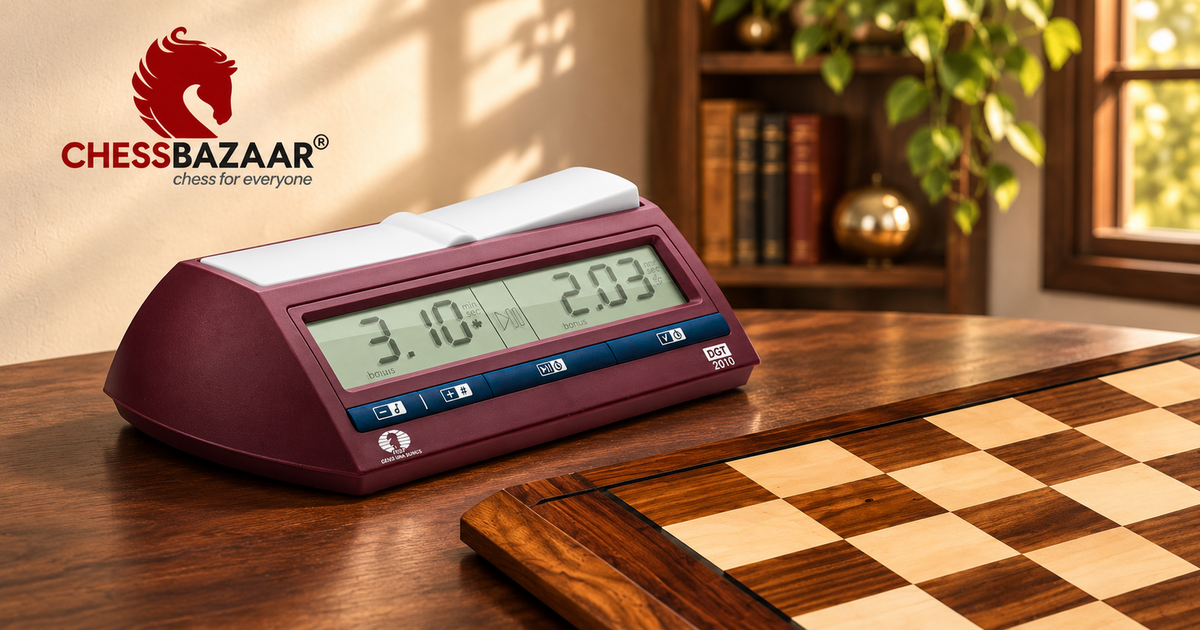
You do not need a chess clock to enjoy a casual game at home. But if both players want fair time limits, practice for club games, or a faster pace, a clock quickly becomes useful. It gives each person a defined amount of thinking time and makes the end of a timed game clear. For many developing players, that is the real reason to buy one.
A chess clock is not the same as a kitchen timer. It has two linked timers: one runs while White is thinking, and the other runs while Black is thinking. After making a move, the player presses the clock to stop their own time and start their opponent’s. The important buying decision is whether you only need basic countdowns or want more flexible timing methods.
When A Chess Clock Is Worth It
You Play Rapid Or Blitz Games With Friends
A timed game creates a different challenge from an unlimited afternoon match. In a 10-minute game, for example, each player gets 10 minutes on their own clock. That makes the pace predictable and encourages practical decisions rather than endless analysis.
You Are Preparing For Club Or Tournament Play
Playing with a clock at home helps build the habit of making a move and pressing the timer correctly. It also lets you practice finishing a game with limited time. Rules and acceptable clock settings can vary by organizer, so check the event’s requirements before choosing equipment.
You Want Structured Family Games
A clock can help when one person tends to spend much longer thinking than everyone else. It is not essential for beginners, and it should not turn an enjoyable family session into a stressful race. Use generous settings until both players are comfortable.
The Time-Control Terms You Need To Know
|
Example |
What it means |
When it may help |
|
10+0 |
10 minutes per player; no extra time per move |
Straightforward timed practice |
|
5+3 |
5 minutes per player plus 3 seconds added per move |
Blitz-style games with increment |
|
15+10 |
15 minutes per player plus 10 seconds added per move |
Longer rapid-style practice |
Increment adds a fixed amount of time to a player’s remaining clock after each move, according to the clock’s timing method. Delay is different: it gives a player a short allowance before the main time starts decreasing, or implements an equivalent delay method. Not every digital clock offers every form of delay, increment, or multistage timing.
FIDE’s current technical guidance for electronic chess equipment explains the kinds of display, controls, programming, and reliability features it expects in regulated settings. Home players do not need to reproduce every tournament requirement, but the guidance shows why readable displays and configurable timing matter.
Digital Or Analog: Which Makes Sense?
An analog chess clock can be appealing if you want simple mechanical countdowns and a traditional look. A digital chess clock is usually the more flexible option if you practice different time controls or need increments. As a buyer, do not assume that “digital” guarantees a particular timing function. Read the selected model’s specifications.
CHESSBAZAAR’s chess clock collection currently features digital models, making it a sensible starting point for readers who want to compare supported timing functions rather than shop by appearance.
What To Check On An Actual Clock Listing
1. DGT 2010: Flexible Timing Combinations
The DGT 2010 Digital Chess Clock listing describes the ability to mix timing methods, including a countdown period followed by Fischer or Bronstein delay. That may be useful if you want to practice more than one kind of time control.
2. DGT 2500: Presets And Customizable Settings
The DGT 2500 Digital Chess Clock product details list 25 preset timing systems, five customizable setting slots, a larger display, and the ability to show seconds from the start. Those are concrete features to compare against your own needs. Always verify the latest listing before ordering.
A Five-Point Chess Clock Buying Checklist
- Your usual games: Decide whether you mainly want 10-minute countdowns, increment games, or advanced multistage controls.
- Ease of operation: Make sure both players can read the display and understand the buttons.
- Timing flexibility: Check that the exact increment or delay methods you need are supported.
- Practical details: Review battery requirements, instructions, and settings memory where listed.
- Tournament requirements: If the clock is for an event, verify its suitability with the organizer instead of relying on a marketing label.
What If You Do Not Need A Clock Yet?
If chess at home is mainly conversation, lessons, or relaxed games with children, your money may be better directed toward a comfortable playing setup. You can explore tournament chess sets or simply keep using the board and pieces you already own until timed games become part of your routine.
The Right Next Move
A chess clock becomes worth buying when time management is part of the experience you want. Start with your usual time control, then compare the model features that support it. Browse CHESSBAZAAR chess clocks, or visit CHESSBAZAAR for boards, pieces, and complete sets.
FAQs
1. Do beginners need a chess clock?
No. It is often better to learn piece movement and basic strategy without time pressure. Add a clock when both players want timed practice.
2. Can a chess clock be used with any chessboard?
A standalone clock normally sits beside the board, so its use does not depend on the board’s square size. Electronic board integration is a separate feature that must be checked by model.
3. What does 5+3 mean in chess?
Each player starts with five minutes and gets three seconds added per move when the selected increment mode is used.
4. Is a digital clock always better?
Not for every purpose. Analog can be enough for simple timed games. Digital is more useful when you want configurable increments, delays, or other timing formats.


