

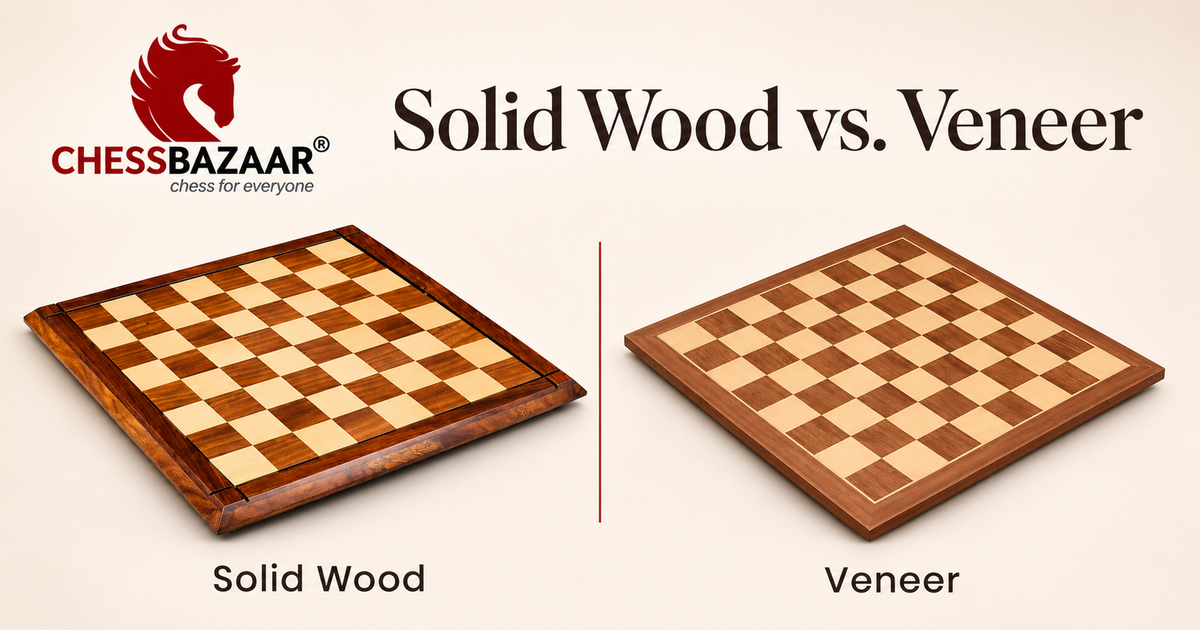
A solid wood chess board and a wood veneer chess board can look remarkably similar in a product photo. The real difference is how the playing surface is built. Solid wood boards use substantial pieces of wood in their construction, while veneered boards use thin sheets of real wood over a supporting core. Neither approach automatically makes a board better for every player. The more useful question is which construction, finish, size, and design suit your games.
At CHESSBAZAAR, shoppers can compare solid wood boards with Spanish veneer chess boards. Our catalog includes Sheesham and maple combinations as well as walnut, ash burl, black anigre, and other veneer designs. These are real product-material choices, not simply different color filters.
The Construction Difference In Plain English
A solid wood board gets its character from the wood components used to form it. Construction may vary by maker, so the label alone doesn't tell you how the squares, border, or backing are assembled. A veneered board uses thin real-wood sheets to create the visible playing surface. That veneer is bonded to a core, but the core material can vary; it should not be assumed to be plywood, MDF, or particleboard unless the listing says so.
Veneer is not the same as a printed imitation of wood grain. It can be genuine wood. The U.S. Forest Service explains how wood products and wood-based panels differ in its Wood Handbook. That is useful background when product labels mention veneer, solid wood, or an engineered substrate.
|
What to compare |
Solid wood construction |
Wood veneer construction |
|
Appearance |
Natural wood forms the construction; grain varies by piece |
Real-wood surface can show striking grain combinations |
|
Build |
Ask how the squares and borders are assembled |
Ask what veneer and supporting core are used |
|
Handling |
Weight varies with size, wood, and thickness |
Weight varies with the core, dimensions, and finish |
|
Best buying question |
Does its build and finish suit my intended use? |
Does its surface, core, and finish suit my intended use? |
What Woods And Finishes Does Chessbazaar Actually Offer?
Sheesham And Maple: Warm Contrast In A Solid Board
The Deluxe Solid Sheesham & Maple Wooden Chess Board, 21 inches, is described with Sheesham and maple materials and 55 mm squares. Its product listing says the purchase includes the board only. That matters if you already own pieces: you can focus on the wood, dimensions, and finish without accidentally assuming new chessmen are part of the order.
Walnut And Maple Veneer: A Different Kind Of Surface
The Standard Walnut & Maple Matte Chess Board, 21 inches, is listed as walnut-and-maple veneer with 60 mm squares and a matte finish. It offers a useful contrast with the solid Sheesham example: the size, wood combination, finish, and construction all change. Compare these measurements before comparing appearance alone.
Ash Burl, Black Anigre, And High-Gloss Options
For a more decorative surface, CHESSBAZAAR also lists boards such as the Red Ash Burl & Maple High-Gloss Board. Its listing specifies a red ash burl veneer and maple combination, 55 mm squares, and a glossy finish. The veneer chess board collection brings together other patterns, including black anigre and dyed poplar combinations. Do not treat a wood-look color or a trade name as proof of a particular species unless the individual listing confirms it.
Matte Or Glossy Matters As Much As The Species
A high-gloss board may appeal to someone building a formal display. A matte surface generally reduces visible reflections under bright lights, which can be useful for regular study, club play, or overhead filming. If the board is meant for regulated competition, consult the organizer’s equipment requirements rather than treating every attractive wooden board as tournament-approved.
Think about where you will actually play. A sunny window seat, a bright overhead lamp, and a dedicated chess table can make the same finish feel very different. A finish choice is personal, but asking about glare is practical.
Four Checks Before Buying Either Construction
- Square size: Look for the square measurement in millimeters or inches, not just the board’s outside dimensions. CHESSBAZAAR examples above have 55 mm and 60 mm squares.
- Your king’s base: Measure the widest piece base and compare it with the board’s recommended range. A board can look large in a photo yet still feel crowded.
- What is included: A chess board product may be sold without pieces. Check the “You’re getting” or package-inclusions section.
- Exact material and finish: Read the selected product page for any differences between solid, veneer, matte, lacquered, or glossy versions.
Which Should You Choose?
Choose a solid wood design if you especially value its construction and the natural look of its wood components. Choose veneer if a particular grain pattern, finish, or board design is your priority. Neither choice excuses poor sizing or unclear specifications. The board you enjoy using is the one that matches your pieces and your room as well as your taste.
You can compare materials in the CHESSBAZAAR chess board collection.
FAQs
1. Is a veneer chess board made from real wood?
Often, yes. Wood veneer is a thin layer of real wood attached to a core. A printed wood-effect surface is different. Read the individual material specification to know what you are buying.
2. Does a solid chess board always last longer?
No simple rule guarantees that. Construction quality, finishing, humidity, storage, and handling all affect a board over time. Evaluate the specific item rather than relying on one label.
3. Is maple always the light square on a chess board?
Maple is commonly used to create a lighter contrast in the products mentioned here, but you should check the actual wood description and photos of each board.
4. Can I use a 60 mm board with the same pieces as a 55 mm board?
Possibly. Measure your king’s base and compare each board’s stated recommendations. The outside dimension by itself cannot answer the fit question.


